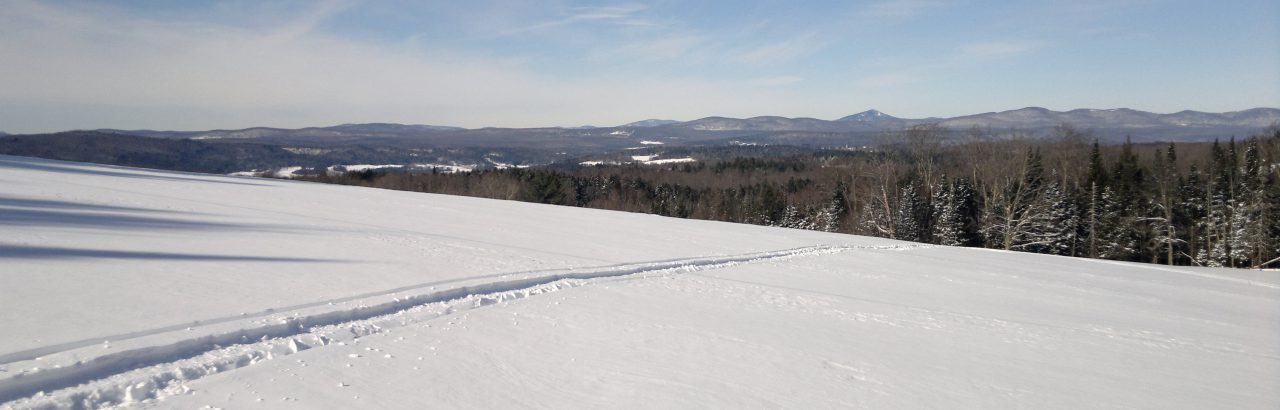
Time to close the curtain on a pretty epic season!
Highlights
- Two major snowstorms in the southern region of the Northeast-US in January and February.
- Polar vortex kept cold air in our region through the month of January, while the far west had an unusually dry and warm winter.
- A brtual warm spell in March rapidly melted a very good snowpack.
- The World Cup comes to Lake Placid.
Beginning
A slightly late start to the season as some of the usual early-start spots in the far north didn’t get much snowfall in November. That said, Rikert, Craftsbury Outdoor Center, Trapp Family Lodge, and Mt. van Hoevenberg started the season just before Thanksgiving, Better still was yet to come, and by Christmas it felt like the Northeast traded places with northern plains states like Montana. Even NYC got in on some early (and increasingly rare) snowfall action.
Middle
The biggest winter news for skiers in the Mid-Atlantic area was the seven continuous weeks of skiable conditions in the NYC metro and downstate region, lasting from January 18 to March 9. Two major snowstorms, one in January and one in February, supplied plentiful snow in the downstate and coastal areas, and a longstanding polar vortex over Canada kept the snowpack intact. The cold spell from early January into early February across eastern North America sent heating bills skyrocketing but was welcome for skiers in downstate NY and southern New England.
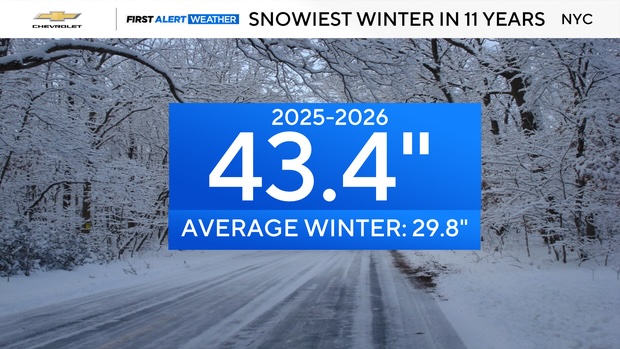
A recap of winter in NYC is the topic of this post from CBS News in NY.
Midwinter snowfall was pretty well distributed across the southern, mid-northern, and norhtern regions of the Northeast-US overall, but the far north received smaller shots so it took some time for the snowpack to build. ‘Good enough’ snow fell regularly enough for the northern Adirondacks, Green, and White Mountains to build a 3′ base at elevation. Lake effect snow continued to deliver to the Tug Hill plateau, as well as contributing to the snowpack across the far north of NY and VT. Placement at the fringe of snowstorms to south and north translated to good conditions across the ‘middle-north’ region from the Catskills through western Massachusetts, southern Vermont, and New Hampshire foothills and lakes.
It was almost boring to survey ski conditions for the ‘state of the touring centers’ during midwinter because the skiability was so regularly good or acceptable. A good kind of boring.
Ending
Mother Nature suddenly opened the door of the pizza oven in early March, sending waves of warm air that raised temps into the mid-60s all the way up to the Canadian border and wiped out the snowpack in the Hudson river valley after the first week.
XC skiing in the NYC metro shut down by March 8, as neither Mohonk or Minnewaska had the snow to keep grooming. A couple of hardy souls went out after that but the going was interrpted by bare spots, ice, and water. Don’t get me wrong -we in the downstate NY region did get seven solid weeks of groomable, skiable snow out of this season. That was a very good run, almost certainly a ten-year record, so no complaints.
As late as March 7 there was still a very good snowpack from the Catskills and Berkshires northward, but by March 11 cover had disappeared in low-lying areas in the southern half of the Northeast-US. In a harbinger of things still to come, Mt. van Hoevenberg shut down trails on March 11. They may have wanted to preserve as much base as possible for the upcoming World Cup races starting on the 20th. Things just kept getting worse despite a few flurries up north, and from March 8 through March 16 the entire Northeast-US had unseasonably warm temperatures as well as rain, culminating in heavy rain over the March 14-15 weekend.
By March 16. Garnet Hill’s conditions were pretty grim. Bretton Woods went offseason as of March 16. Great Glen also close trails for the week of the 16th. In Vermont, Wild Wings did likewise. Notchview in the Berkshires also closed trails for skiing by March 16. There was still some snowpack left after more than one week of warmth and rian, but yet another week would mean serious trouble. At mthe end of the week of 3/16 a nose of warm moist air shoved colder air aside and delivered rain over the 3/21-22 weekend. During the week ending March 22, fourteen touring centers closed trails or called it a season.
In the final ten days of March, a see-saw of rising and falling temperatures and rain or scattered snow showers gave rise today-by-day changes in conditions. Passable conditions and trails could be found in the Tug Hill, Adirondacks, northern Greens, and White mountains until the 22nd. After that the writing was on the wall, and a week after the spring equinox, just 13 out of 47 touring centers that I track were open.
As of April 1 you could say the season was ‘toast’. In a couple of recent winters a March snowstorm would breeze in and refresh the snowpack for some good skiing. This year a cold high pressure bubble up in Canada kept midwinter temps north of the US, and Quebec had snow showers from moisture channeled up there by a high pressure zone offshore of the Mid-Atlantic coast. The warm air off the coast brought temps in NYC to the upper 70s. By late March the snowpack had been melted away, and only those areas that had been stockpiling manmade or natural snow were able to keep a minimum of trails open. Lapland Lake, Gore, and Trapp squeaked into April for a ‘bronze medal’ in spring grooming longevity, while Craftsbury and Oak Hill (!) held on till April 5 to claim silver. Gold went to Bolton Valley.
Taking note
We lost the following groomed trails operations recently:
- Cascade ski/visitor center, Lake Placid NY – bought by the ADK but plans to renovate fell through,
- Canterbury Farm, Becket MA – owners retired and closed the B&B.
- Cyrstal Lake Ski and Outdoor Center, Hughesville PA – no longer grooms for skiing.
‘Adventure skiing’
I began seeing some areas describe trails that weren’t groomed recently and having some hazards as suitable for ‘adventure skiing’. The phrase applies nicely to skiing backcountry or jeep trails, and nordic trails that are purposely or generally ungroomed, such as those at Bolton Valley and Blueberry Hill. For most other touring centers, it gives a nice gloss to poor skiability.
Not the end, but a finale
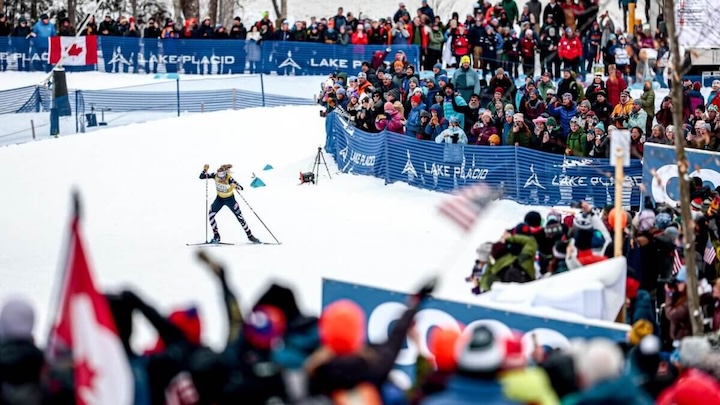
Notice must be taken that the end of our season saw the World Cup come to Lake Placid, and doubled as a commemoration of Jessie Diggins’ career- a retirement party of sorts. Some details about the occasion:
- On arriving in the Adirondacks, some teams thought the area so unpopulated there would be few in attendance. Understandable, given that in Europe nature is contained and constrained by human development all around. The ‘Dacks are sprawling, wild, and wooly on purpose. Not everyone who lives there is happy about the limits on development.
- 35,622 people in total went to Mt. van Hoevenberg across the three days of raciing (according to ORDA, the Olympic Regional Development Authority). That’s 10,000+ people each day crowded along the competition trails, not spread out oacross the village.
- The population fo Lake Placid is 2,200 (US Census). Saranac Lake, the largest community in the Adirondacks and a few miles from Lake Placid, has a population of just under 5,000. I’d liken the influx of visitors to having two huge cruise ships disgorge their passengers on a small community for three or four days. Not sure how doubling or tripling the human presence compares with other tourist or ski towns. If anyone knows of national or regional stats, I’d be interested to know where to find them.
- Mother Nature sent several inches of heavy wet snow on Friday the 19th, dry weather on the 20th, and rain on the 21st. A busy weekend for the wax techs and groomers.
- Weather and lack of practice in handling such huge crowds caused hours-long delays for people using shuttle buses on Friday, but the local organizers rallied and things got better for the rest of the weekend.
- Diggins crashed in the 20k on Sunday finishing 12th, but had already locked up the overall and distance World Cup awards on Friday by finishing 5th in the 10k.
- Italian racer Federico Pellegrino, like Diggins, retired at the end of the season. Both began an eighteen-year career in the 2008-09 season. Diggins is 34, Pellegrino is 35. So young to have a potential mid-life career crisis at hand!
- Diggins’ first recorded FIS race result was Nov. 2008; her first international race was in Jan. 2009. In addition fo four Olympic medals and seven World Championships, she’s started 385 World Cup races, and 576 FIS races, for an average of 32 starts per year.
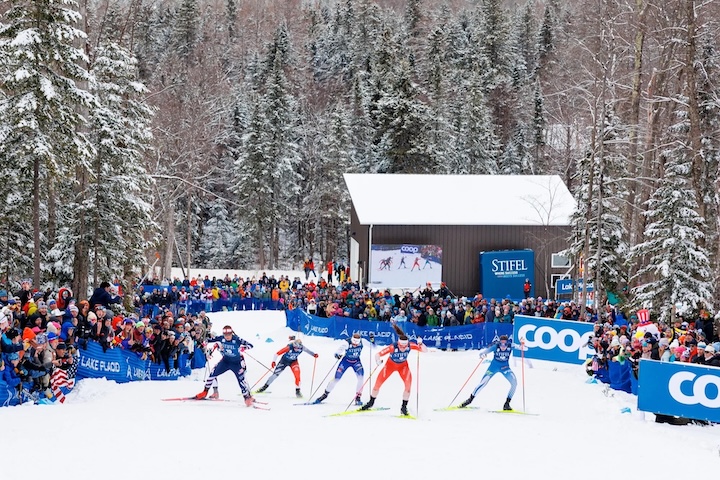
Dedicated Nordic skiers from across the continent came to see the elite racers and Olympic medal-winners, including Jessie Diggens, Ben Ogden, Gus Schumacher, and the rest of the US Ski Team. According to reports and first-hand accounts, the fans cheered everyone, including the European teams, often knowing non-US racers by name as well. Reports of the enthusiasm of the American crwod sounded intense and maybe a bit unexpected by the Europeans.
An aspect that Jessie Diggins and Federico Pellegrino shared was a positive energy with teammates and on the start line. People at the sidelines or their screens have long appreciated it. The crowds along the trail gave some of it back to Pellegrino during warm-up for the sprint race, chanting his nickname ‘Chicco Pelle’ in chorus. He credits the fans for giving him the kick of emotional energy he needed to win one last race.
If part of the nordie fan mission was to reinforce the idea of putting North America into regular location rotation for World Cup races, then mission accomplished. Thanks to teams, spectators, and organizers for coming to this part of the world. Mom could have given the last races better weather, but- not complaining!- it was nice bookend to the season nonetheless.
 Across the Snow Line