The story goes: three blind people are put next to an elephant and told to describe it. Each one touches a different part, and based on incomplete knowledge of the whole, has a different description of the animal.
Even someone who skis a lot is typically interested in certain aspects of the activity. Nonskiers and newbies in particular receive partial and fragmentary information. The industry doesn’t always help because it’s focused on maximizing revenue from the most dedicated (ie, specialized) skiers. The act if skiing can be dressed up in layers of marketing- and competition-speak.
Two forms of technique
There are two fundamentally different techniques in cross-country skiing that lead to different choices in ski equipment. The videos below show and describe them in brief:
The techniques are illustrated on groomed trails that you’d find at a touring center. If you ski on ungroomed terrain (eg, golf courses, rail trails, hiking trails or forest roads) you’ll be using classic technique. For real backcountry skiing, it will involve classic-style skiing on uphill and fats. There are special conditions where skate skis or skate technique can be used in natural ungroomed terrain, but they’re uncommon.
Diagrams to the rescue
Cross-country skiing has several variations on a single idea: self-propelled movement across a variety of terrain on skis. More dramatic slopes and sport or competition has driven development of skis and skiing into different niches, adapted to those specific conditions.
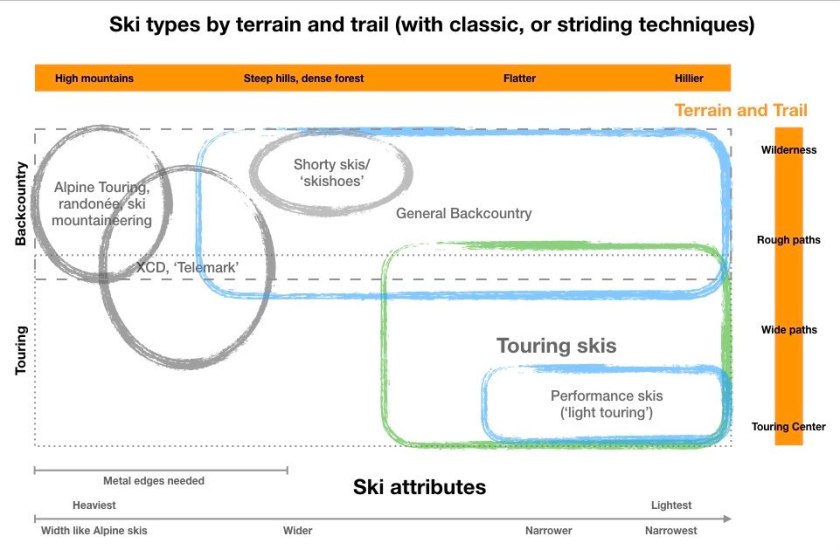
Purpose and terrain specificity leads to incompatibilities of equipment- for example, skis and boots designed for groomed trail performance are poor choices for backcountry, and vice-versa. Decisions get harder at the boundaries: when would you choose short fat skis or ‘skishoes’, over a standard backcountry ski? Do you want general touring or ‘sport’ skis?
I did the best I could to update my scope of knowledge and definition of terms, and render the relationship between skis, terrain, and trail coherently. In the end I decided to have six categories for skis used with ‘classic’ technique. You might decide differently.
The first graph is for ski types used for classic or striding techniques (at least on the flat and uphill parts):
And one for skate ski applicability:

It’s not exactly surprising that skate skis look kind of lonely in the terrain-and-trail graph. It’s a specialized discipline to begin with, given there’s just one ski type for all skate, vs. six different types for classic.
There’s also a narrow set of conditions where skate skis are a usable option. But the fact that they’re usable in places that newcomers are more likely to start with (ie, flatter terrain and touring centers) makes them look like an equivalent alternative to classic touring skis. I guess they are, if your intention is to ski on flatter trails at touring centers!
 Across the Snow Line